Carthage's Fatal Ambush
Gang Up: A Bikerland NovelCarthage's Fatal Ambush is the decisive escalation that turns a covert struggle over Abigail into a declared war between the Family and the Cauldron. Troy organizes a small trusted team, leads the attack himself, and kills Carthage on the road; the murder then compels Brall to answer with immediate retaliation while making the Cauldron's conflict with the Family collective rather than personal.
Causes and Immediate Stakes
The ambush follows the news that the Cauldron has taken Abigail and subjected her to indoctrination. Troy initially reacts with bilious anger at having been excluded from the information, but the revelation quickly gives his resentment a direction. He dresses and orders Pontoon to gather five or six trusted men, explicitly distinguishing them as their own men and limiting the party to those they can trust. The small size of the force suggests a deliberate strike rather than an open battle, while Troy's sudden sense of purpose shows how Abigail's indoctrination becomes the pretext for an aggressive Family response.
Carthage becomes the target because he is encountered on the road and is closely associated with Brall's Cauldron leadership. The attack therefore carries a meaning beyond the death of one fighter. The Cauldron has claimed Abigail as its own, and the Family answers by striking one of the people who embody that opposing order. What begins as a contested act of indoctrination is converted into a reciprocal logic of collective punishment.
The Attack on the Road
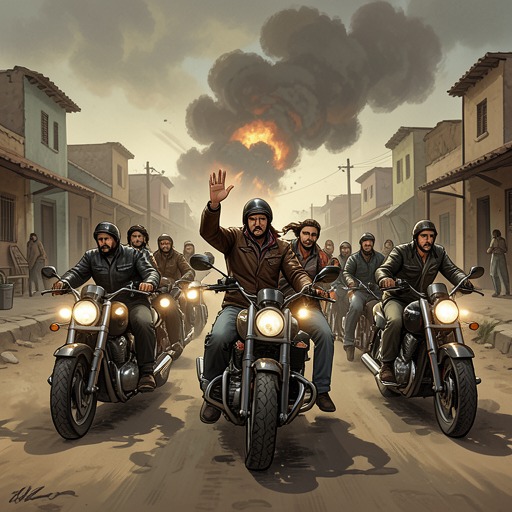
Brall encounters the approaching party before the violence begins. Bikes rumble along the trail in a convoy that he does not expect, and Troy rides at its head with his gun drawn. The narrative gives Brall only a moment of foreknowledge: he can see the attack coming, but not soon enough to warn anyone or alter its course. That narrow interval turns recognition into helplessness, making the ambush feel less like a contest than a mechanism already set in motion.
Two riders rush Carthage in succession. Chains swing into him, and a pipe traveling at roughly fifty miles an hour strikes his leg, knocking him to one knee. He remains conscious enough to swear and promise revenge, but the second bike crashes into his head and completes the takedown. Troy then passes over him and shoots him three times in the back. The seven attackers do not remain to fight; they ride away together, leaving Carthage motionless in the road, dead or dying. The sequence is fast, coordinated, and asymmetric, replacing open combat with a planned execution carried out through speed, machinery, and numerical advantage.
The attack also exposes the difference between Troy's chosen method and Brall's immediate response. Brall orders Garner to bring back a head from the fleeing men or not return, sending him and six others after Troy's group. Yet Brall himself stays behind to recover Carthage's barely living body and to guard against another assault. His decision is not simple hesitation. The Cauldron requires its leadership to remain present whenever another attack may follow, because its response to each contingency is governed by protocol. Even while pursuing revenge, Brall must preserve command and protect the group from collapse.
Carthage's death therefore changes the conflict's scale. The Cauldron had taken Abigail and made her one of its own through indoctrination; the Family answered by killing a Cauldron man; the Cauldron now faced the obligation to answer that killing in turn. The narration identifies this as the moment when the two factions enter the same cycle of collective retaliation. An attack on one member is treated as an attack by the entire Family, so Brall rejects the possibility that responsibility can remain limited to Troy or to the few riders who carried out the ambush. Carthage's body on the road becomes the visible proof that a private grievance has become a war between organized communities.
Recognition, Retaliation, and War
The killing is first reported as a wound to Brall’s immediate world: Carthage was not merely a fallen fighter but “Your Carthage,” the person whose death makes the attack intimate as well as political. When the news reaches Temple, Brall explains that Carthage was shot on the road leading into the settlement. The report initially prompts disbelief that Case could have authorized so reckless an act, since an assault on one of Brall’s men would almost certainly begin a war. Brall’s answer shifts the question from individual guilt to collective responsibility. Whether Case personally ordered the attack or another Family authority did so, the riders came through under the Family’s protection, and the Family’s own doctrine had repeatedly declared that an attack on one member was an attack on all. Carthage’s death thus destroys the possibility of treating the ambush as an isolated crime: it becomes the proof by which Brall defines the Family as a single enemy and justifies the Cauldron’s mobilization.
Narrative Consequences
Carthage's Fatal Ambush is also a crisis of knowledge and authority. Troy's fury begins with the realization that everyone else has been told about Abigail while he has been excluded, but the news of her indoctrination converts wounded status into violent purpose. The attack therefore reveals how information is distributed within the Family: being left out is experienced not merely as a personal insult but as evidence that Troy's position and influence have been diminished. His response is to reassert agency through a tightly controlled expedition, selecting only men he believes can be trusted and placing the operation outside any broad, transparent process of deliberation.
For Brall, the killing produces the opposite movement. Troy's attack is sudden and personal in its execution, but Brall answers through collective procedure. He sends Garner and six others after the attackers, orders a retaliatory trophy, and remains with Carthage's body because leadership must be present if another assault follows. The contrast establishes two competing forms of power: Troy acts through secrecy, speed, and a small loyal circle, while Brall responds through command responsibility, prescribed protocol, and the preservation of the Cauldron's institutional continuity. Carthage's death tests whether the Cauldron can retaliate without abandoning the structure that makes it a governing force.
The event also fixes the political meaning of the Family's doctrine of mutual defense. Brall insists that it is irrelevant whether Case gave the order personally, because the attack was carried out by Family men and therefore implicated the Family as a whole. This interpretation turns affiliation into liability: membership offers protection, but it also makes every violent act representative of the entire group. Once Carthage has been killed under that collective logic, the Cauldron cannot treat the ambush as a dispute between Troy and Brall. The killing becomes the immediate foundation for the Family–Cauldron War, with Abigail's indoctrination as its concealed origin and Carthage's body as its undeniable public fact.
In narrative terms, the ambush is a value reversal from contested possession to open bloodshed. Abigail's fate had already violated the Family's sense of control, but the death of Carthage makes the cost bodily, visible, and irreversible. Brall's helpless foreknowledge, the coordinated blows from the bikes, Troy's three shots, and the riders' rapid disappearance compress the transition into a few violent moments. Afterward, there is no stable middle ground: the Cauldron has lost one of its leaders or leading men, the Family has declared its willingness to strike, and both sides possess a reason to understand restraint as weakness. The road attack is consequently not only Carthage's death; it is the scene in which retaliation becomes the governing grammar of the wider conflict.